Zelal Al Arabia
A Riyadh kitchen manufacturer with a 4.6★ Google rating from 109 reviews, and a website that never mentioned it. I rebuilt the site around the trust they already had, plus a configurator that turns a visit into a qualified WhatsApp brief.
مطبخك يحكي أصالة بيتك.
Zelal Al Arabia designs and builds kitchens from their own factory in Riyadh: modern, classic, wood and aluminium, with instalments through Tabby and Tamara.
Their customers clearly like them. The Google profile carries a 4.6 rating across more than a hundred reviews. But the website told a different story: filler text left on the contact page, an empty projects page, a headline with nothing under it, and not a single word about that rating.
So I rebuilt it. Nobody briefed me and nobody paid me. It is an unsolicited prototype, made because the gap between the reputation and the website was obvious.
The reputation was there. The website wasn't carrying it
A kitchen is a five-figure decision that customers research for weeks. The website is where that research lands, and it was the weakest link in an otherwise solid business.
Proof that stayed hidden
Over a hundred happy customers on Google, and a homepage that showed none of them. The rating now sits in the hero, with real quotes further down.
Leads with no context
A phone number alone means the first call is twenty questions. The configurator asks them up front, so the sales team opens WhatsApp to a brief, not a hello.
Trust is in the details
Placeholder text and empty pages read as neglect. Every page in the redesign is filled with their own facts: instalments, delivery time, factory, address.
Warm, local, and theirs
A Najdi direction: plaster tones, arched frames and a triangle motif borrowed from Riyadh architecture, set in Reem Kufi with copy written in Saudi dialect.
Real photos first
The gallery uses their own installs, curated by hand. Reposted and watermarked images were left out. Only the hero image is AI-generated, and it is labelled as such in my notes to the client.
Questions a buyer actually asks
Shape, material, colour, budget. Four taps, each one large enough for a thumb, with a progress bar and a summary before sending.
Facts, not adjectives
Rating, address, instalment terms and delivery time are quoted exactly as the business states them. Anything unconfirmed, like warranty years, was left out rather than guessed.
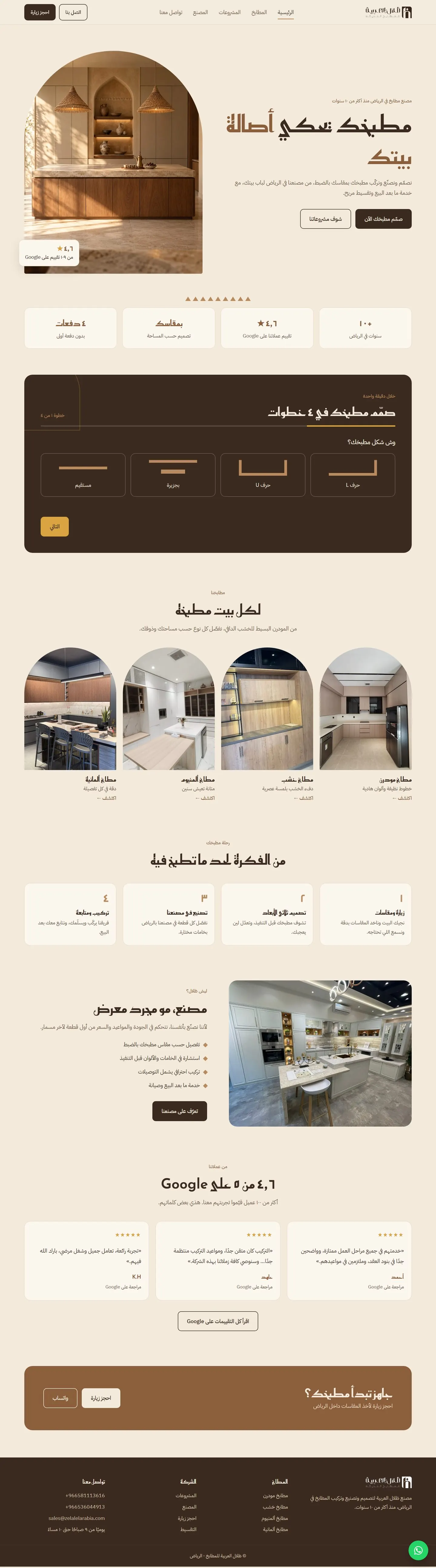
The prototype stops at the interface, so it can ship as a static site on day one.
Natural next steps are a proper projects archive with the factory's own high-resolution photography, a booking calendar for measurement visits, and tracking that shows which channel each WhatsApp brief came from.
Tell me what you are building.
Send the idea, the goal, and where you are stuck — I will come back with the clearest path from concept to a store or site that earns its keep.